In-Between
Homecoming Exhibition of the Japan Pavilion at the 19th International Architecture Exhibition – La Biennale di Venezia
2026/1/24-2026/3/1
Venue [ Ohsui House ]
-
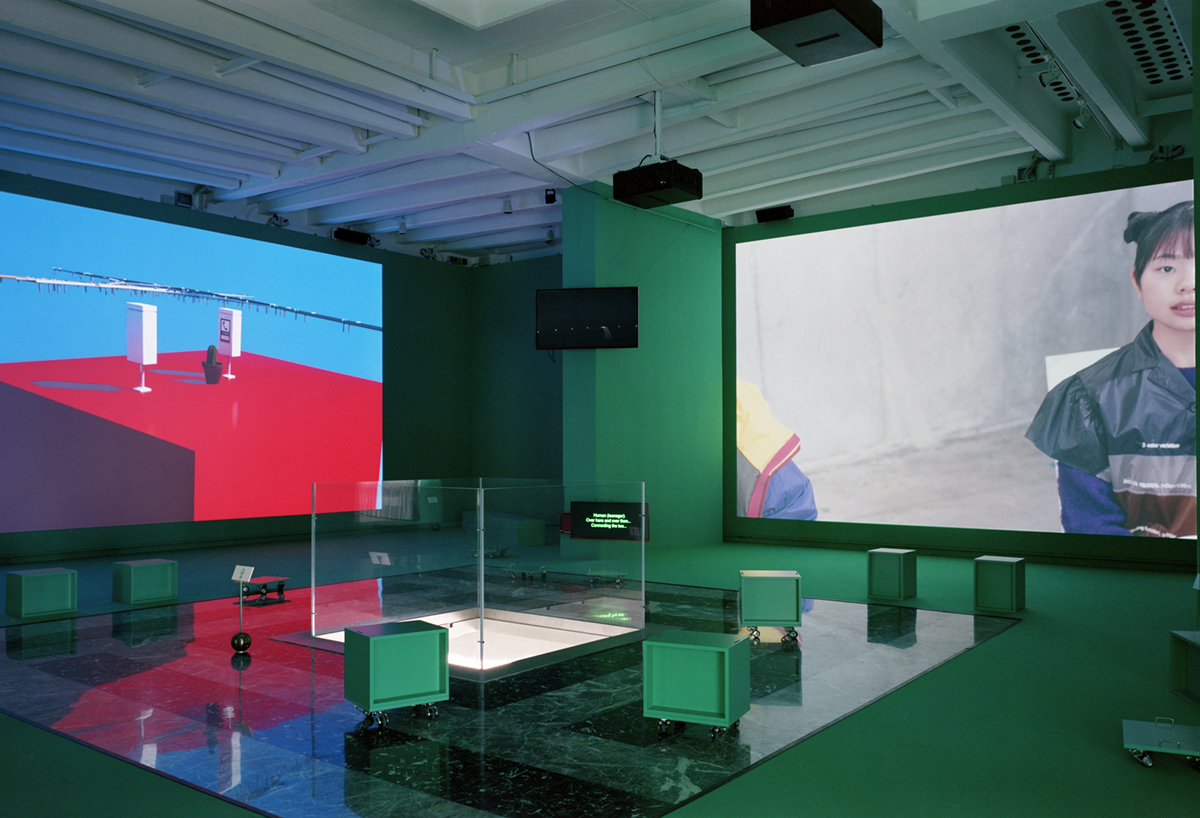
Installation view at The Japan Pavilion at the 19th International Architecture Exhibition – La Biennale di Venezia © Yurika Takano The Japan Pavilion at the 19th International Architecture Exhibition – La Biennale di Venezia (held in Italy from May 10 to November 23, 2025) presented a vision of the future with generative AI as a site for dialogue opened “in-between” humans, non-humans and the environment. The exhibition featured a rarely seen configuration where two works —one, an installation in the ground-floor pilotis and outdoor space by SUNAKI (a collaborative studio led by Sunayama Taichi and Kiuchi Toshikatsu), the other an installation in the first-floor gallery by Fujikura Asako and Ohmura Takahiro—were combined in a reciprocal way to resonate as a single piece. The curation was led by Aoki Jun and Iemura Tamayo.
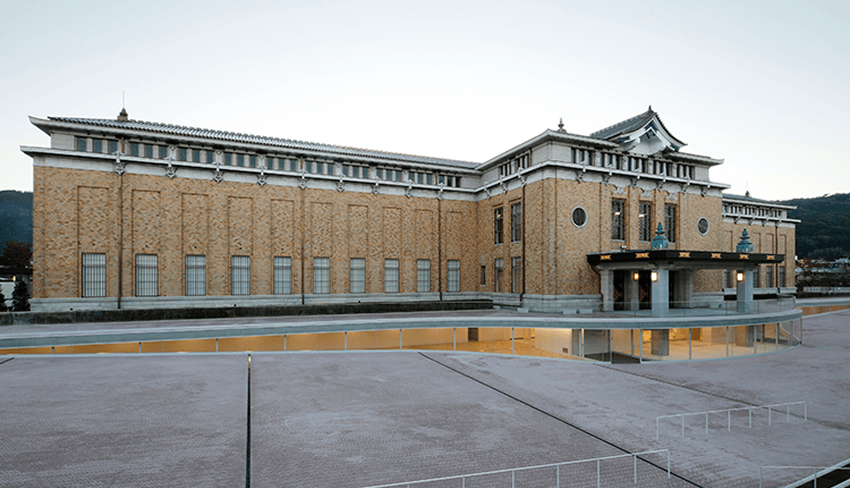
Utilizing the partially renovated spaces of the mu seum’s former office building (now named Ohsui House) that was constructed in 1933 on the museum grounds at the time of its founding, this homecoming exhi bition invites the three entities—the curatorial team and two artist teams—that intersected at the exhibition in Venice to independently reconfigure the works for display in Kyoto. While home-coming exhibitions of the Japan Pavilion at La Biennale di Venezia have been held in the past, this is the first attempt to hold such an event outside of Tokyo in both the art and architecture fields. By hosting it here in Kyoto, a city home to numerous higher education institutions of art and archi tec-ture, we aim to foster further cultural ex change and creative develop ment both in Japan and internationally.
The Japan Pavilion at the 19th International Architecture Exhibition – La Biennale di Venezia
Details
Installation view at The Japan Pavilion at the 19th International Architecture Exhibition – La Biennale di Venezia © Yurika Takano Information
- Period
- January 24 (Sat.) – March 1 (Sun.), 2026
- Time
- 10:00 – 18:00 (Last admission 17:30)
- Venue
- Ohsui House
- Closed on
- Mondays (except for February 23, a public holiday,
when it will be open)
- Admission
Free admission
Visitor Information
• Since the venue is a semi-outdoor space, please take necessary precautions such as wearing warm clothing before your visit.
• As the venue utilizes an unfinished state of construction, please refrain from touching the exposed wood, concrete and other surfaces of the floor and walls.
• Be cautious of uneven ground surfaces. We recommend wearing stable, comfortable footwear for your visit.
• Eating and drinking are not allowed inside the venue.
• There are no restrooms, lockers, or cloakrooms inside the venue. Please use the facilities in the main building.
• Pets are not allowed inside (except for guide dogs and service dogs).
• Not fully accessible due to ongoing renovation work. Please contact us in advance regarding wheelchair or stroller accessAoki Jun (Curator) / Born in 1956 in Yokohama. Architect. Graduated with a master’s degree in architecture from the University of Tokyo in 1982. Founded Jun Aoki & Associates (now AS) in 1991, currently serving as director. Director of the Kyoto Municipal Museum of Art (commonly known as Kyoto City KYOCERA Museum of Art). Professor emeritus at Tokyo University of the Arts.
Iemura Tamayo (Curatorial Advisor) / Born in 1960 in Tokyo. Independent curator. Graduated with a doctorate from Tokyo University of the Arts in 1992. Former curator at the Meguro Museum of Art from 1991 to 2009. Has served as professor in the Department of Art Studies at Tama Art University since 2016.Fujikura Asako / Born in 1992 in Saitama Prefecture. Artist. Graduated with a bachelor’s degree in Persian Studies from Tokyo University of Foreign Studies in 2016. Completed a master’s degree in Film and New Media at Tokyo University of the Arts in 2018.
Ohmura Takahiro / Born in 1991 in Toyama Prefecture. Office of Ohmura director. Completed coursework for the doctoral program at the Graduate School of Science and Technology, Tokyo University of Science in 2020. Holds a doctorate in engineering. Assistant professor in the Graduate School of Science and Engineering, Department of Urban and Civil Engineering, Ibaraki University.Ohmura Takahiro / Born in 1991 in Toyama Prefecture. Office of Ohmura director. Completed coursework for the doctoral program at the Graduate School of Science and Technology, Tokyo University of Science in 2020. Holds a doctorate in engineering. Assistant professor in the Graduate School of Science and Engineering, Department of Urban and Civil Engineering, Ibaraki University.
Kiuchi Toshikatsu / Born in 1978 in Tokyo. Co-representative of SUNAKI Inc. Associate professor at the Center for the Possible Futures at Kyoto Institute of Technology. Completed a master’s degree in architecture at the University of Tokyo in 2004.
Sunayama Taichi / Born in 1980 in Kyoto. Co-representative of SUNAKI Inc. Associate professor in the Department of General Science of Art at Kyoto City University of Arts. Completed the doctoral program in architecture at the Graduate School of Fine Arts, Tokyo University of the Arts. Holds a doctorate in fine arts.
- Organized by: City of Kyoto, AS
- Supported by: Aoki Jun Supporters Association
-
Archival Exhibition Plan: Jun Aoki + Tamayo Iemura
Sound Engineer: Makoto Oshiro
Film making: Rikako Takahashi (houses inc.)
Video presented by: YKK AP Inc. -
SUNAKI Area Exhibition Plan: SUNAKI | Taichi Sunayama + Toshikatsu Kiuchi + Haru Teraoka + Issei Korda
- Parallelly displaced Tilted Loop Path of the Japan Pavilion
Project Management: Haru Teraoka
Structural Design: Graph Studio (Mika Araki, Hirotaka Ujioka)
Fabrication: Kobayashi Metal Industries
Construction: Yamaken Construction, Dai Sawai
- Parallelly displaced ground of the Japan Pavilion
Project Management: Issei Kouda
Construction: Yusuke Kurazono
- Drawings of the Displacement Process
Production: Taichi Sunayama, Haru Teraoka
- Sample of the iPhone exhibited in Venice (Automated Dialogue)
Programming: Taichi Sunayama
- Sample of the Clay Rail exhibited in Venice (Tilted Loop Path)
Fabrication: BARNA Gergely Péter, Issei Kouda, Toshikatsu Kiuchi
Fabrication Assistance: Taihei Mizutani, Ryosuke Nakahara,Yoshiyasu Saito, Ryotaro Yamaguchi, Sota Araki -
Asako Fujikura + Takahiro Ohmura Area Exhibition Plan: Asako Fujikura + Takahiro Ohmura
Sound Engineer: Makoto Oshiro
Technical Engineer: Yuya Ito
Composer: ermhoi
Installation Assistant: Shinako Nakamoto
Film Production: KAORU [Kaoru Mitsui] (Food Stylist), Alice Ogi (Food Assistant), Lisa Aoki (Director of Photography), Shuma Ozawa (Camera operator, Colorist), Harumi Suzuki (Camera Assistant), Takahiro Fujii (Film Lighting Expert), Saeko Naruke (Lighting Assistant), Takeshi Ishida (Lighting Assistant), Eri Kanzaki (Production Manager), Arisa Ueji (Hair and Make-up Artist), Satoko Shinya (Styling), Hidetoshi Inanaga (Prop Construction)
CG Production: Ai Ikeda (Rendering Coordinator), Miki Nigo (Motion Designer), Yudai Kato (Assistant), Taiyo Sumi (Assistant)
Actors: Kie Onikubo, Shuji Morita, Takuto Ohta, Rie Allison, Kyoko Ano
Voice Actors: Kevin Mchugh, Ena Morita, Shuji Morita, Julia Shortreed, Jua, HIMI, ermhoi
Musicians: Yuri Kamei (1st Vn), Tomohiro Ishii (2nd Vn), Mei Mishina (Viola), Sonoko Muraoka (Vc), Marty Holoubek (Double Bass), Taikimen (Marimba) -
Graphic Design: Akiko Wakabayashi
Book Editor: Nao Amino
Title Font: Tariq Heijboer
Support Staff: Tomoko Shinagawa
Construction: Branco Inc.
Public Relations: Kyoto City KYOCERA Museum of Art, Project Management Office
-
1F SUNAKI (Kiuchi Toshikatsu & Sunayama Taichi)
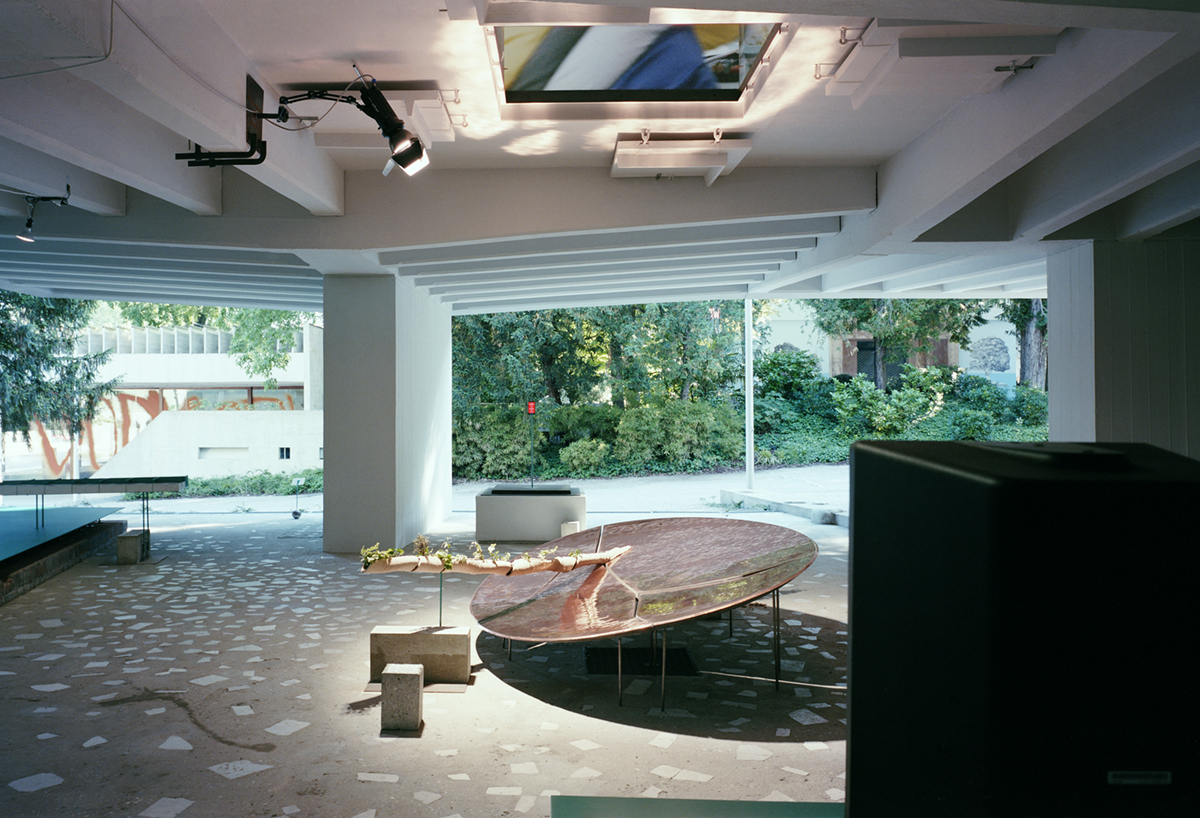
Installation view at The Japan Pavilion at the 19th International Architecture Exhibition – La Biennale di Venezia © Yurika Takano SUNAKI (Kiuchi Toshikatsu & Sunayama Taichi)
Imagine a vertical rod sliding horizontally across the Earth’s surface as it travels from Venice to Kyoto. Seen from outer space, the rod appears to trace an arc, as if attached to the tip of a clock’s hand. It tilts gradually as it moves around the Earth’s center. This tilt is imperceptible, even when viewed from the ground.
In Venice, our conversations with Aoki and other members revolved around such imaginations.
In an age of AI, we are conversing above a vast accumulation of images and fragments of language stored in the cloud. Yet, these contain the traces of cries and hopes uttered by someone in a distant place and time, surfacing in response to our questions. Though we perceive only the surface, an un imaginable depth extends beyond. The active imagination is drawn to what exists there.
Architecture is an endeavor in which, while handling the materials before us, we simultaneously consider gravity and time on a planetary scale. Distant things quietly slip beneath our feet.
In the Venice exhibition, the centerpiece was a video in which seven elements that comprise the Japan Pavilion engaged in a dialogue with one another. We created devices to perceive two of these—the Hole and Tilted Loop Path—which do not exist in physical form. A gaping Hole in the center of the pavilion’s ceiling and floor and a Tilted Loop Path that circles the pavilion, a building erected on a slope. We believe that the ability to treat what is not there as if it were present lies at the core of architectural imagination. For the homecoming exhibition, the Tilted Loop Path was moved from Venice to Kyoto. Not as a physical object, but as a concept. Instead of sliding laterally along the Earth’s surface, we decided on a straight line of movement when seen from a cosmic perspective. In Kyoto, the ground of Venice stands at 84°43’1.03”, making the Tilted Loop Path even more slanted.
An “in-between” as a small exercise in bringing distant events closer to hand.Installation view at The Japan Pavilion at the 19th International Architecture Exhibition – La Biennale di Venezia © Yurika Takano 2F Fujikura Asako + Ohmura Takahiro
Installation view at The Japan Pavilion at the 19th International Architecture Exhibition – La Biennale di Venezia © Yurika Takano What Fujikura and Ohmura attempted in Venice was a “fictional reno-vation” of the Japan Pavilion at La Biennale di Venezia. This was not a physical intervention, but rather a reconfiguration of the human per-ception of architecture among the people drawn into a “dialogue” arising between the pavilion’s constituent elements—Hole, Wall Columns, Outer Walls, Pensilina, Brick Terrace, Tilted Loop Path, and Yew Tree—that were imagined as possessing their own viewpoints. For this homecoming exhibition, the work has been newly recomposed to fit the conditions of Ohsui House. Here, the overarching theme of “in-between” is ap proached in two ways. Ma (in-between time/space) emerges where multiple irrec-on cilable “selves” coexist. The two devices for observing this externally are the Human Video (HV) and Objects (O). HV shows five humans gathered around a dining table, presenting the materiality of the human body and time’s irreversibility as one extreme of the dialogue. O, in contrast, is like a marker, physically illuminating the element that is currently speaking. To correspond to the fiction of assigning viewpoints to various objects, each actor is assigned a light source—an illuminated cone. The Construction Video (CV), created using 3DCG, builds a fictional landscape using words spoken in the dialogue as material each time they are uttered. With the bodies and imaginations of the creators as medium, the worlds perceived by the Hole, Wall Columns and other elements collide and struggle against one another on screen. In doing so, CV attempts to draw the viewer into the very midst of the in-between. The videos, dialogue and audio are syn chronized and shown in approximately seventeen-minute cycles, emerging together as a single event.
Installation view at The Japan Pavilion at the 19th International Architecture Exhibition – La Biennale di Venezia © Yurika Takano